Undergraduate Programme

BSc (Hons) Artificial Intelligence and Robotics

Why this Programme?

This course is designed to address engineering skills-shortage in intelligent hardware/software systems and applied robotics as an enabler to ongoing AI revolution across a range of sectors such as Autonomous Vehicles, Aviation, Construction, Telecommunication, Software Systems, Military, and Consumer Electronics.

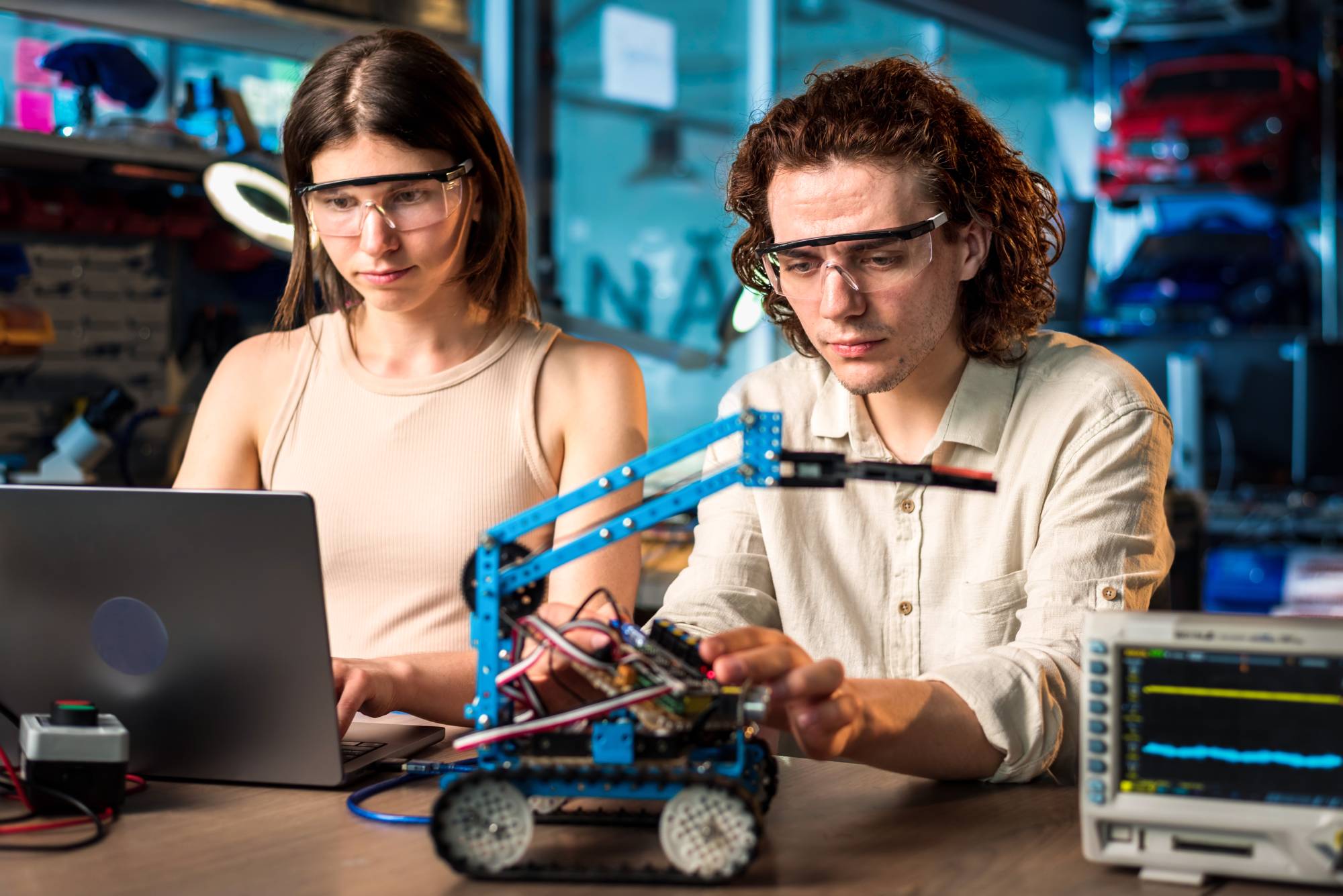
The course provides experience in the design and development of robotics systems, from the initial hardware design and development to writing and implementing advanced AI software to enable robots to accomplish tasks in the real world. The course is structured with a strong emphasis on practical work to build your skills and confidence in the usage and application of contemporary Robotics and AI technologies. Students will learn the elements needed to build robots, from simple electronic circuitry, software engineering and control, to high-level robot intelligence, and will learn how to develop robotic systems and bring the learning to life

Modules

Level 4

CT4001NM Communications Engineering (30 credits)

Communications Engineering is essential across various industries, facilitating seamless data transmission, networking, and real-time communication. In Telecommunications, it serves as the foundation for mobile networks, fibre-optic communication, satellite communication, and broadband infrastructure, enabling global voice, video, and data transmission. In Healthcare, it supports telemedicine, remote patient monitoring, and electronic health records (EHRs) by ensuring secure and efficient communication between healthcare providers and patients.

This module introduces fundamental concepts in Information and Communication Technology (ICT), providing students with a clear understanding of its principles and real-world applications. It explores how ICT is integrated into everyday life and examines its impact across various sectors. Additionally, the module addresses key ethical, social, economic, and environmental issues related to the ICT field, encouraging critical thinking about its broader implications. 

CT4002NM Electronics Systems (30 credits)

Electronic systems are essential across various industries, enabling automation, communication, and efficient data processing. In Consumer Electronics, they drive smartphones, laptops, smartwatches, and gaming consoles, ensuring seamless connectivity and fast processing. In Healthcare, electronic systems power medical imaging devices, pacemakers, robotic surgical systems, and patient monitoring tools. 

This module introduces students to the most-used electronic devices and their applications in small-scale electronic systems. It is divided into two main sections: Analogue and Digital Electronics.

The module combines formal lectures and seminars with hands-on practical sessions, allowing students to apply theoretical knowledge in a laboratory setting. Through these sessions, students will gain experience in using test and measurement equipment and simulators, developing essential skills in electronics testing and application. 

The aims of the module are as follows: 

  •  To familiarise students with commonly used electronic components, standard laboratory test and measurement equipment, and their usage in designing/analysing, building, and testing simple electronic circuits/systems. 
  • To introduce students to circuit simulation software and develop an awareness of its strengths and limitations 
  • To introduce students to the electronics and measurement techniques through practical approach and provide scope for putting theory into practice and develop investigation/analysis skills that exemplify core electrical and measuring principles relevant to the course. 
  • To develop the ability to write a well-structured, concise and thoughtful logbook / report / poster. 
  • To develop the ability to work independently as well as in team. 

MA4005NM Logic and Mathematical Techniques (30 Credits)

This module develops a range of mathematical techniques including set theory, logic, relations and functions, algebra, differentiation, and integration. The techniques provide the foundation for further study of mathematics and related applications in Computer Science, Computer Games Programming, Computer Systems Engineering and Robotics, and Electronics and Internet of Things. 

CS4001NM Programming (30 Credits)

This is an introductory Programming module, designed to develop interest, ability, and confidence in using a programming language. Students will gain the basic knowledge and experience to solve simple programming problems using established techniques in program design, development, and documentation. It is expected that on completion of this module, students will be able to design, implement and test object-oriented programs. 

The student is also expected to develop their confidence needed to program solutions to problems through a series of practical programming exercises. 

Modules

Level 5

CT5003NM Microprocessors & Embedded Systems (30 credits)

Microprocessors are essential across various industries, driving automation, data processing, and intelligent decision-making. In Healthcare, microprocessors power medical devices such as MRI scanners, ultrasound machines, pacemakers, insulin pumps, and wearable health monitors, enabling accurate diagnostics and real-time patient monitoring. In Consumer Electronics, microprocessors are integral to smartphones, laptops, tablets, smartwatches, and gaming consoles, ensuring fast computing, seamless connectivity, and efficient data processing. In Telecommunications, they are found in network routers, switches, and mobile communication towers, facilitating secure and high-speed data transmission. 

This module introduces students to microprocessors and the role that hardware and software play in the functional behaviour of microprocessor systems. Students are then introduced to some of the more common microcontrollers. Interfacing external memories as well as various input/output devices and sensors are also covered.

The module enables students to analyse the requirements of a given task, make decisions in selecting an appropriate controller, design and implement prototype hardware/software for a typical embedded systems product.

Practical workshops are designed to introduce microprocessor software development, testing and debugging.  Workshops provide students with an opportunity to use both ‘C’ and assembly language. 

CT5051NM Advanced Electronics Systems (15 credits)

Electronic systems are essential across various industries, enabling automation, communication, and efficient data processing. In Consumer Electronics, they drive devices such as smartphones, laptops, smartwatches, and gaming consoles, ensuring seamless connectivity and rapid processing. In Healthcare, these systems power critical technologies including medical imaging devices, pacemakers, robotic surgical systems, and patient monitoring tools, all of which contribute to improved diagnostics and patient care. 

This module builds on the knowledge gained in the first-year module CT4002: Electronic Systems, providing students with hands-on experience in electronic system design through group-based case studies. Students work collaboratively to solve real-world design challenges, applying their skills in analysis, design, and troubleshooting of mixed-signal systems involving both discrete components and integrated circuits (ICs).  

The module follows a structured engineering process, incorporating research skills, system-level analysis and design, circuit simulation, PCB prototyping, soldering, and testing, allowing students to gain practical experience with real-world electronic systems. Delivered in a laboratory-based setting, this module promotes a balanced level of autonomy, encouraging personalized learning, creative problem-solving, and the development of transferable skills essential for future engineering careers.

CT5055NM AI for Robotics (15 Credits)

The “AI for Robotics” module offers students a thorough exploration of implementing AI within the Robotics domain. Covering essential algorithms like Simultaneous Localization and Mapping (SLAM), Automatic Navigation (AutoNav), computer vision, etc., students gain hands-on experience in algorithmic implementation through practical workshops.

Students will also be introduced to real-world applications spanning industrial automation, autonomous vehicles, and medical robotics, analysing case studies to understand AI’s transformative impact and learn about robotic perception and cognition tasks in this process. Working methodologies of equipment such as LIDAR, odometry sensors, stereo cameras etc., will also be taught to students such that they are able to select the appropriate hardware for their application. 

Moreover, students will navigate the legal and ethical landscapes surrounding Robotics, including health and safety regulations, intellectual property rights, and ethical considerations.

Through a blend of formal lectures, hands-on workshops, and interactive discussions, this module equips students with the skills to effectively integrate AI into Robotics solutions while fostering a critical awareness of societal implications. One of the aims of this module is to also ensure that the students are well equipped for the module “AI with ROS” which they will be undertaking in the upcoming semester. 

CT5056NM AI with ROS (15 Credits)

The “AI with ROS” module has been meticulously crafted to offer students a comprehensive hands-on experience in implementing cutting-edge AI algorithms. Designed to equip students with the skills required to thrive as ROS developers in the Robotics industry, this module encompasses practical workshops focused on implementing SLAM and AutoNAV algorithms. Through immersive learning experiences, students will tackle diverse scenarios, honing their ability to implement various AI algorithms while enhancing critical thinking skills.

Emphasizing the utmost importance of safety and compliance, students will navigate health and safety regulations pertinent to AI and Robotics. This includes considerations for intellectual property rights and ethical guidelines, ensuring responsible and lawful implementation of algorithms.

Distinguished as a pioneering initiative, this module prioritises hands-on learning, providing students with unparalleled opportunities to engage directly with ROS development. Students undertaking this module will have the chance to cultivate their own ROS environments, facilitating the seamless integration of sensors and hardware within simulation environments tailored to specific applications.

During the course of this module, students will also be given TurtleBots to implement their algorithms which they have simulated in a real-life environment. Through the “AI with ROS” module, students will not only gain practical expertise but also develop a profound understanding of the ethical, legal, and technical dimensions of AI and Robotics.

FC5W51NM Work Related Learning (15 Credits)

This module consists of a short work placement (or work-related activity) lasting over one semester. This usually translates into 12 to 15 full working days (or the part time equivalent of this) in the framework of 150 hours (15-credit module) considering some time for reflection, research, and documentation. The work placement is facilitated by University’s Work Based Team (WBT) and Careers and Employability Team.

The module enables students to undertake an appropriate short period of professional activity, usually related to their course at Level 5 (Intermediate level), with a business or community organisation and to gain credit for their achievements. The activity can be a student’s part-time job, a volunteering activity, an employment activity, or an activity related to a client’s brief or business start-up activity.

The module aims to provide students with the opportunity to: 

  • gain a useful experience of the working environment. 
  • undertake a real work-related activity/project appropriate at level 5. 
  • enhance and extend their learning experience by applying and building on their    
  • academic skills and abilities by tackling real life problems in the workplace. 
  • understand the importance of social justice, equality, diversity & inclusion in an educational and working environment. 
  • enhance professional and personal development. 
  • plan and record self-learning and development as the foundation for lifelong  
  • learning/continuing professional development 
  • develop employability related skills such as preparing for interview, tacking employer  assessment and IQ tests.

CT5057NM Sensors, Actuators and Control (15 Credits)

In the dynamic field of Sensors, Actuators, and Control Systems are the foundational elements that orchestrate the seamless interaction between mechanical components and digital control. This module, ‘Sensors, Actuators, and Control,’ delves into the intricate theories and practical applications that govern these critical components, particularly emphasising their roles within robotic systems. 

The curriculum is designed to: 

Elevate Understanding of Classical Control Systems:
We aim to cultivate a robust theoretical foundation in classical control systems, enriching this knowledge through its application to real-world scenarios, notably in robotic systems. This exploration will cover the essential principles and extend to the latest advancements in control theory, providing a comprehensive understanding of how these systems can be optimized for precision and efficiency. 

Demystify Transducers and Actuators:
Through an in-depth examination, students will gain insights into the working principles, operations, and the diverse array of transducers and actuators. This module will unravel these devices’ technical complexities and practical applications, highlighting their critical role in translating electronic commands into physical action. 

Provide Hands-on Experience with Sensor and Actuator Systems:
Practical sessions are integrated into the module to offer students first-hand experience with sensor and actuator systems. These sessions are designed to bridge theory with practice, allowing students to apply their knowledge in configuring and troubleshooting mechatronic systems. 

Deep Dive into Mechatronic System Building Blocks:
The overarching goal is to foster a profound understanding of the fundamental components of practical mechatronic systems. By the end of this module, students will be equipped with the knowledge and skills to design, analyse, and implement sophisticated mechatronic systems, particularly in robotics. 

CT5052NM Network Operating Systems (15 Credits)

Network Operating Systems (NOS) are crucial across various industries, ensuring efficient communication, security, and resource management among networked devices. In corporate and enterprise networks, businesses depend on NOS for file sharing, email servers, cloud computing, and centralised security management, enabling seamless collaboration and data protection across multiple locations. In Healthcare, NOS supports hospital networks, electronic health records (EHRs), telemedicine platforms, and medical imaging systems, facilitating secure and efficient data sharing among Healthcare professionals. Additionally, they enable real-time patient monitoring and remote diagnostics, ensuring continuous and reliable healthcare services. 

This module provides both theoretical and practical knowledge of NOS, introducing students to some of the most widely used NOS platforms. Through a combination of lectures, seminars, and hands-on workshops, students will learn to install, configure, manage, and troubleshoot network operating systems. Practical sessions reinforce theoretical concepts, allowing students to gain real-world experience in network administration and system management. 

The aims of this module are:  

  1.  To understand the importance of NOS 
  2.  To explain the operation of Network operating systems, and their benefits  
  3.  To describe hardware requirements for the effective operation of NOS  
  4.  To compare some of the most commonly available NOS, and their abilities and limitations  
  5.  To understand the concept of virtualisation and its application in modern server environments  
  6.  To understand server documentation, security and trouble shooting 

Modules

Level 6

CT6056NM Applied Robotics (15 Credits)

This module aims to provide students with the technical background and skills necessary to design and construct robotic devices. It reviews a selection of sensors and actuators that are commonly used in robotic products and provides students with practical experience in the design, construction, and evaluation of relatively simple fixed and mobile robots.

It also helps students develop an awareness of legal requirements governing robotics, including personnel, health & safety, intellectual property rights, product safety, and liability issues.

The module covers the necessary background through formal lectures/seminars followed by comprehensive hands-on practical workshops.

CT6057NM Computer Vision (15 Credits)

Computer Vision is widely used across industries to automate processes, enhance efficiency, and improve decision-making. In Healthcare, it plays a crucial role in medical imaging diagnostics, while in the Automotive industry, it powers self-driving cars by enabling object detection and navigation. Manufacturing relies on computer vision for quality control, ensuring consistency and defect detection in production lines, while Retail leverages it for cashier-less stores and customer analytics. Additionally, Robotics heavily depends on computer vision for navigation, object recognition, and task automation in warehouses, factories, and even space exploration. By enabling intelligent automation and real-time analysis, Computer Vision continues to transform various industries. 

This module aims to equip students with the knowledge and skills to analyse, design, and develop image processing algorithms commonly used in commercial computer vision systems. It covers fundamental principles, mathematical foundations, algorithmic implementations, and practical configurations of computer vision technology. Upon successful completion, students will be able to professionally evaluate the key components of computer vision systems and apply their knowledge to real-world applications.

CT6066NM Bio-inspired AI and Security (15 Credits)

The multidisciplinary intersection of biology and embedded digital security, the ‘Bio-inspired AI and Security’ module offers an immersive exploration of cutting-edge security algorithms inspired by the complexity and adaptability of biological systems. This module is designed to address the multifaceted challenges of cybersecurity through the lens of genetic algorithms, artificial immune systems, swarm intelligence, neural networks, biometric security, and memetic algorithms. 

Students will engage with the foundational principles of natural science and engineering to devise solutions for complex cybersecurity problems with content that remains at the forefront of technological advancements. Through a dynamic blend of formal lectures/seminars and hands-on workshops, the curriculum not only imparts theoretical knowledge but also fosters practical skills in designing security solutions that harmonise societal, user, business, and customer needs, integrating considerations of health and safety, diversity, inclusion, and environmental stewardship. 

Crucially, the module emphasises evaluating these bio-inspired solutions’ environmental and societal impacts, aiming to minimise adverse consequences and promote sustainability. It adopts an inclusive approach to engineering practice, underlining the paramount importance of equality, diversity, and inclusion in fostering innovative solutions and advancing the field of bio-inspired AI and security. 

CT6058NM IoT Systems and Security (15 Credits)

IoT Systems and Security play a crucial role in various industries, enhancing efficiency, automation, and data-driven decision-making while ensuring protection against cyber threats. In Healthcare, IoT is widely used for remote patient monitoring, RFID tracking, and connected medical devices, requiring strong security measures to safeguard sensitive patient data. The Retail and Supply Chain sectors relies on IoT for RFID tracking, inventory management, and logistics, where robust security helps prevent theft and fraud. In Finance and Banking, IoT enhances security through biometric authentication and fraud detection, ensuring the safety of financial transactions. 

The module is designed to provide students with technical knowledge and skills on Internet of Things (IoT) technologies. Theoretical material delivered in the lectures is supported by practical lab work to ensure students have a sound grasp of the technical content where students are expected to develop IoT systems. A number of devices, platforms and software tools will be introduced during the course from different vendors. The module is assessed through lab reports and final examination. 

CT6053NM Digital Systems Applications (15 Credits)

This module extends the digital design techniques learnt at intermediate level to the use of Application Specific Integrated Circuits. It provides an extensive treatment of the use of Virtual Hardware Description Language (VHDL) using the industry’s standard (Xilinx/Altera and its associated hardware). 

CT6064NM Broadband Systems 1 (15 Credits)

Broadband systems are essential for enabling high-speed communication, data exchange, and automation across a wide range of sectors. In Telecommunications, they underpin high-speed internet, mobile networks, and satellite communications, facilitating seamless global connectivity. In Healthcare, broadband technology supports telemedicine, remote patient monitoring, and the rapid transmission of medical imaging data, contributing to improved patient care and diagnostics.

This module introduces students to the principles and applications of broadband systems and technologies. It covers system operations, design requirements, and analytical approaches, equipping students with both theoretical understanding and practical design skills. The module also develops teamwork and collaboration abilities through a group-based project.

CT6065NM Broadband Systems 2 (Credits 15)

Satellite and optical systems are essential components of broadband technology, supporting various industries. Telecommunications rely on satellite communications for global connectivity, particularly in rural and underserved areas, while optical fibre networks form the backbone of high-speed internet, enabling broadband services, cloud computing, and 5G/6G networks. In Healthcare, satellite broadband facilitates telemedicine, remote diagnostics, and emergency communication in remote locations, while optical fibre ensures fast and secure transmission of medical imaging, electronic health records, and real-time patient monitoring, enhancing efficiency in hospitals and research institutions. 

The module provides students with an understanding and knowledge in the principles and applications of satellite and optical systems broadband systems. It covers the key features of these systems, their operations and design requirements. The module develops analytical and design knowledge and provides experience of team working through a group work. 

CT6052NM Wireless Networks (Cisco) (15 Credits)

This module aims to provide students with the technical background and skills necessary to design and configure and maintain wireless LANs (Local Area Networks) and WANs (Wide Area Networks). Knowledge of LANs and WANs is essential across various industries, enabling secure communication, data management, and operational efficiency. In Healthcare, LANs connect medical devices and records within hospitals, while WANs enable secure data exchange, telemedicine, and compliance with regulations. The Education sector uses LANs for campus networking and WANs for remote learning and institutional collaboration. In Finance and Banking, LANs manage transactions and cybersecurity, while WANs link branches and support online banking. Retail and E-Commerce rely on LANs for inventory and POS systems, while WANs connect stores, warehouses, and online platforms. Similarly, Manufacturing and Supply Chains use LANs for automation and real-time tracking, while WANs coordinate global logistics. 

This module focuses on the design of these networks, the devices used and their operation, the planning prior to installation and best practices, the implementation of the network design, security provisions, and troubleshooting of Wireless LAN issues. The module covers the necessary background through formal lectures/seminars followed by comprehensive hands-on practical workshops. 

CU6061NM Artificial Intelligence (15 Credits)

This module provides an introduction to the field of Artificial Intelligence, from its historical context to its current state. Students will research an aspect of AI and work in teams to design an intelligent system and develop a simple prototype. 

The module aims to: 

  • build students’ knowledge and understanding of AI and its range of applications;
  • enable students to use their skills and knowledge to design a contemporary intelligent system;
  • develop students’ critical faculties with respect to the ethics and the issues surrounding AI;
  •  to build skills in software engineering and prototype development.

FC6P01NM Project (30 Credits)

The module enables students to demonstrate their acquired knowledge and skills through a systematic and creative investigation of a project work, either individually or as part of a group, in accordance with their course requirements. The topic of investigation will cover a broad spectrum of various analysis and techniques and will lead to a comprehensive and concise academic/industry-related report. Students will be assisted in exploring areas that may be unfamiliar to them and encouraged to develop innovative ideas and techniques. Students will be able to choose a project that may require the solution to a specific problem, creation of an artefact in a real-world environment or an investigation of innovative ideas and techniques related to an area within their field of study. Collaboration with outside agencies and projects with industrial, business or research partners/ sponsors will be encouraged. 

Rankings

A top 10 UK

university for student experience

(The Times and Sunday Times Good University Guide 2024)

A top 10 UK

university for teaching quality

(The Times and Sunday Times Good University Guide 2024)

Top 25% of UK

universities for social inclusion

(The Times and Sunday Times Good University Guide 2024)

A top 20 UK

university for student support

(Daily Mail University Guide 2024)

A top 50 UK

university for graduate salaries

(Daily Mail University Guide 2024)

Click the button below to enroll in your desired course or request essential study materials effortlessly.

Request Course Prospectus